Score Interpretation
High IQ Score — What the Thresholds Really Mean
A high IQ score is not a single number — it is a set of thresholds, each with a specific percentile position, statistical rarity, and practical meaning. This guide covers every major high-score classification from 110 (High Average) to 130+ (Very Superior) and beyond, with the percentile data behind each band, how high-IQ society admission works, what research says about what these scores actually predict, and what to do constructively after getting a high result.
Understanding what your score means — relative to which population, on which instrument, under what conditions — matters more than the number itself.
What Counts as a High IQ Score?
The most widely used classification framework — the Wechsler Adult Intelligence Scale (WAIS-IV), published by Pearson Assessments — defines three primary “high” bands above the population midpoint of 100. Each band boundary corresponds to an exact multiple of the 15-point standard deviation (SD), not an arbitrary line.
110+
High Average
75th – 90th percentile
Top 10–25 % of the normed population. The informal threshold most people describe as a strong or above-average result. About 1 in 6 people score here.
120+
Superior
91st – 97th percentile
Top 3–9 %. Frequently used as a cognitive threshold in selective academic programmes and professional aptitude screening. Clearly high by every clinical standard.
130+
Very Superior
≥98th percentile
Top 2 %. Exactly two standard deviations above the mean. The Mensa admission threshold on approved clinical tests. About 1 in 50 people reach this level.
Why the 15-Point Standard Deviation Defines the Boundaries
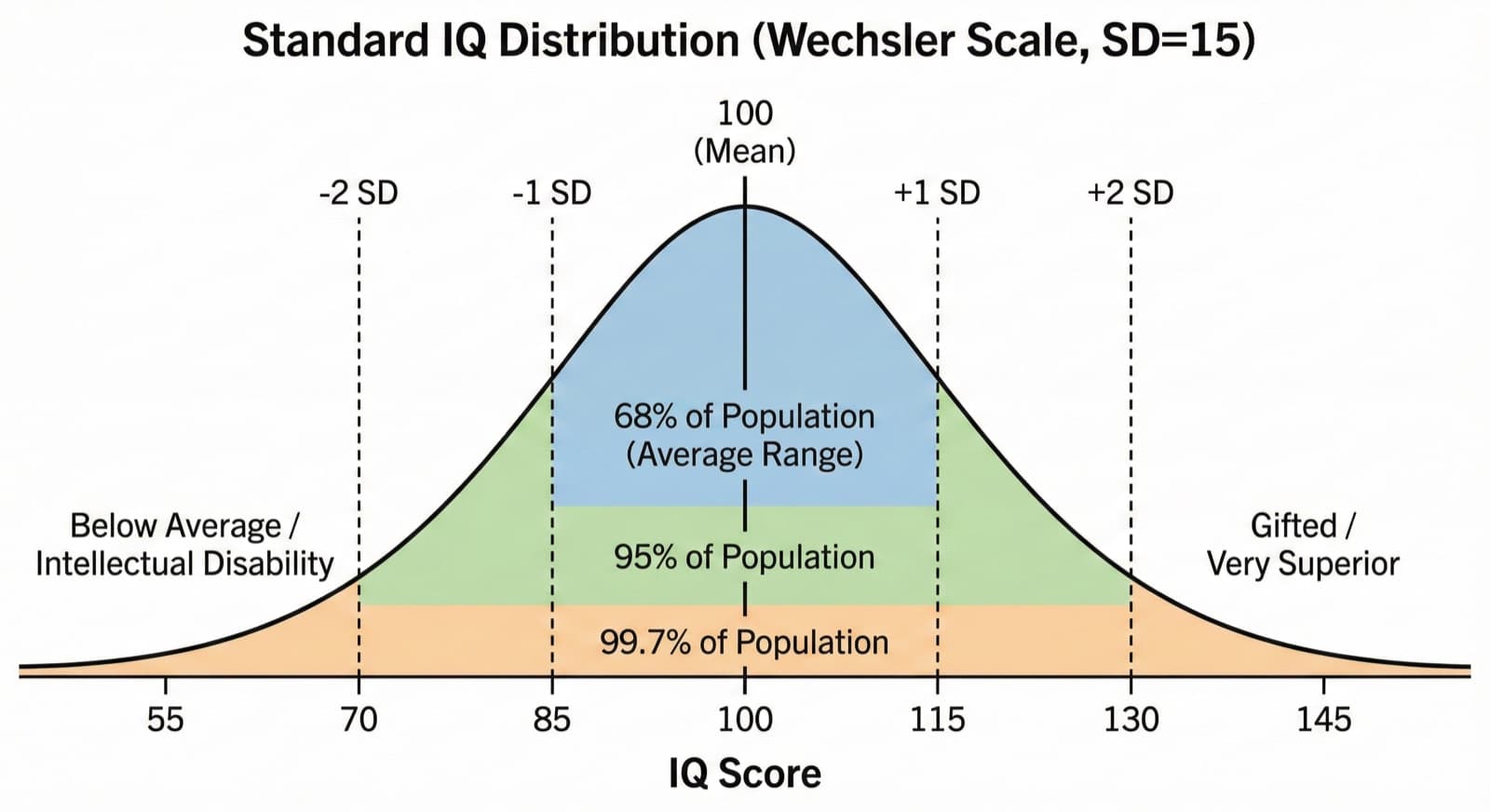
IQ tests are scaled so that the mean is 100 and the standard deviation is 15. Every 15-point increase above 100 represents one additional “step” of rarity. The band boundaries — 115, 130, 145 — fall on exact SD multiples, which is why they feel significant: they are precise statistical thresholds, not convention.
- IQ 115 = +1 SD → top 16 % of the normed population
- IQ 130 = +2 SD → top 2 %
- IQ 145 = +3 SD → top 0.13 %
Context Dependency: The Same Score in Different Settings
A score of 115 is clearly “high” relative to the general population. In a doctoral programme cohort where the average applicant scores 120–125, a 115 sits below the group mean. Always interpret a high score relative to the specific comparison context, not only the global normed average.
Standard Error of Measurement at High Scores
All IQ tests carry a standard error of measurement (SEM) — typically 3–5 points on well-normed clinical instruments, and somewhat higher on online assessments. A reported result of 130 might represent a true score anywhere from roughly 125 to 135. At extreme scores, the SEM matters more for accurate interpretation. A single high result warrants a second clean-session confirmation before drawing firm conclusions.
Giftedness Levels: Miraca Gross's Taxonomy
Educational psychologist Miraca U. Gross identified five levels of giftedness based on longitudinal data from intellectually advanced students. These are used in some gifted education frameworks and offer finer granularity than the WAIS band labels alone: mildly gifted (115–129), moderately gifted (130–144), highly gifted (145–159), exceptionally gifted (160–179), and profoundly gifted (180+).
High IQ Score Percentile Reference Table
The table below maps specific high IQ scores to their approximate percentile, population share, and standard-deviation distance from the mean. Values apply to tests using mean 100 and SD 15. For the complete range including below-average bands, see the full IQ score ranges guide.
| IQ Score | Classification | Approx. Percentile | % of Population | SD from Mean |
|---|---|---|---|---|
| 140+ | Profoundly High | ≤99.6th | ≈0.4 % | +2.67 SD |
| 135 | Very Superior | ≈99th | ≈1 % | +2.33 SD |
| 130 | Very Superior | ≈98th | ≈2 % | +2.0 SD |
| 125 | Superior | ≈95th | ≈5 % | +1.67 SD |
| 120 | Superior | ≈91st | ≈9 % | +1.33 SD |
| 115 | High Average | ≈84th | ≈16 % | +1.0 SD |
| 110 | High Average | ≈75th | ≈25 % | +0.67 SD |
| 100 | Average (midpoint) | 50th | ≈ 50 % below | 0 SD |
Percentiles are approximations derived from the standard normal model. Values vary slightly by test instrument, norm year, and demographic weighting.
How to Read Your Percentile Position
A percentile tells you what share of the comparison population scored below you — not how many questions you answered correctly or how hard the test was. The 91st percentile means 91 % of the normed reference group performed below your level. It says nothing about absolute difficulty or raw item count.
Why Exact Score Matters Within a Band
The 10-point Superior band (120–129) spans the 91st to 97th percentile — a 6-percentile-point spread that represents a meaningful population difference. A score of 121 and a score of 128 both carry the label “Superior” but sit in quite different positions. Always check the exact percentile your test reports, not just the band label. For context on what the midpoint of 100 means, see the average IQ score guide.
Explore Every High-Score Band
Expand any band below for a full breakdown of its percentile position, population rarity, and practical notes. Classifications follow the WAIS-IV system (mean 100, SD 15).
140+Profoundly High≈0.4 % of the population≈ 99.6th +
≈0.4 % of the population • +2.67 SD
Scores above 140 sit more than 2.67 standard deviations above the mean. Standard psychometric instruments lose precision at this level because norming samples contain very few participants here. Most online tests are not adequately calibrated to produce reliable scores above 140 — treat any such result as highly approximate. Specialised instruments such as the extended Stanford‑Binet norms are designed for this range.
- Very few instruments — online or clinical — are normed to differentiate reliably above 140.
- The Triple Nine Society requires the 99.9th percentile (≈ IQ 146+). Prometheus requires the 99.997th percentile.
- If you consistently score in this range across multiple controlled sessions, a supervised clinical assessment is the appropriate next step.
130+Very Superior≈2 % of the population≥98th percentile
≈2 % of the population • +2.0 SD
A score of 130+ sits exactly two standard deviations above the mean of 100. This is the most widely cited threshold for formal giftedness classifications and the standard cut-off for most high‑IQ societies, including Mensa International, on approved supervised tests. Roughly 1 in 50 people in the normed population reach this level.
- This is the Mensa admission threshold — but only on approved, proctored tests (not online assessments).
- Score variance is proportionally larger at extremes: a 5-point swing matters less percentile-wise than near the centre.
- Consistency across two or more clean sessions under controlled conditions is a stronger signal than a single peak result.
120–129Superior≈7 % of the population91st–97th percentile
≈7 % of the population • +1.33 to +1.93 SD
The Superior band sits between one and two standard deviations above the mean. A score here places you in the top 3–9 % of the normed population — meaningfully above what most academic or professional selection processes consider a strong result. The 9-point spread within this band (91st to 97th percentile) represents real population differences: a score of 121 and 128 both carry the label “Superior” but sit in different positions.
- Many selective academic programmes and gifted-screening processes operate in the 120–130 range for cognitive aptitude.
- Practice gains within this band are real but smaller than in lower ranges — eliminating specific error types yields more than broad strategy changes.
- Consistent performance in the 120s typically requires controlled sessions, good pacing, and low error rates on spatial rotation items.
110–119High Average≈16 % of the population75th–90th percentile
≈16 % of the population • +0.67 to +1.27 SD
The High Average band is what most people informally mean when they say someone has a high IQ score. It represents clear above-median performance — better than 75–90 % of the reference population — without reaching the statistically rarer Superior classifications. About 1 in 6 people score here, so it is not exceptionally rare, but it is consistently above average by every major standard.
- Scores of 110 (75th percentile) and 119 (90th percentile) carry meaningfully different population positions — always check your exact percentile.
- Pacing improvements and targeted practice on harder matrix item types are the most effective levers at this level.
- This range covers the most common target for standardised academic admissions and many professional screening tools.
Percentile ranges based on a standard normal distribution. Clinical SEM of 3–5 points means band edges are not sharp thresholds.
Mensa and High-IQ Societies: Thresholds Compared
High-IQ societies are membership organisations for people who have demonstrated performance at or above a specific percentile on an approved cognitive test. The thresholds vary significantly — from Mensa’s 98th percentile to Prometheus’s 99.997th percentile. For a dedicated breakdown of admission routes, see the Mensa IQ score guide.
| Society | Threshold | IQ Equivalent | Notes |
|---|---|---|---|
| Mensa International | 98th percentile | ≈ 130 (WAIS, SD-15) ≈ 132 (SB5, SD-16) | Largest high-IQ society. Accepts scores from a list of approved supervised tests. Does not accept online tests. |
| Intertel | 99th percentile | ≈ 135+ (SD-15) | Accepts clinical and some supervised scores at the 99th percentile on approved instruments. |
| Triple Nine Society | 99.9th percentile | ≈ 146+ (SD-15) | Requires documentation from approved clinical tests. Very few standard instruments are normed at this level. |
| Prometheus Society | 99.997th percentile | ≈ 160+ (SD-15) | One of the most selective high-IQ societies. Standard tests cannot reliably differentiate at this extreme. |
What Mensa Actually Accepts
Mensa International requires a score at or above the 98th percentile on an approved psychometric test administered under controlled, proctored conditions. The specific qualifying IQ score depends on the scale used: approximately 130 on the WAIS (SD-15), 132 on the Stanford-Binet 5 (SD-16), and 148 on the Cattell III B (SD-24). Mensa’s FAQ explicitly states that online tests are not accepted for admission.
Most national Mensa chapters offer their own supervised admission test as an alternative to submitting prior clinical scores. This is commonly the most accessible route for new applicants.
Why the Scale Matters: WAIS vs Stanford-Binet vs Cattell
Different tests use different standard deviations. A score of 132 on the Stanford-Binet (SD = 16) is statistically equivalent to 130 on the WAIS (SD = 15) — both sit at exactly 2 SDs above the mean. This is why Mensa specifies the 98th percentile rather than a fixed IQ number: the percentile is the invariant quantity, not the raw score.
IQMog Is Not a Qualifying Test for Any High-IQ Society
IQMog provides an online IQ-style assessment built on a Raven’s progressive matrices format. It produces an indicative score with a percentile estimate, but it is not a proctored or clinically administered instrument and does not qualify as evidence for any high-IQ society, academic institution, or employer selection process. It is a useful reasoning benchmark and self-orientation tool — not a substitute for a formally administered assessment.
Seeking a Formal High-IQ Assessment
Contact a licensed psychologist and request a full cognitive assessment using a standardised instrument such as the WAIS-V or Stanford-Binet 5. The American Psychological Association’s overview of intelligence testing covers what proper clinical assessment entails and what it can and cannot tell you.
What Research Says a High IQ Score Predicts
Decades of differential psychology research have established IQ scores as one of the strongest single predictors of certain outcomes at a population level — while also showing meaningful limitations at the individual level.
What the evidence supports
- Educational attainment: One of the strongest cognitive predictors of academic performance and degree completion.
- Job performance: Meta-analyses consistently find general intelligence among the best predictors of occupational performance, especially in complex roles.
- Decision quality: A 2025 University of Bath study found individuals with higher IQ made life-expectancy forecasts more than twice as accurate as those with the lowest scores.
- Income potential: Correlates moderately with lifetime earnings at a population level, though with wide individual variance.
Important limitations
- Individual variance is wide: Population-level correlations do not translate into reliable individual predictions. High IQ does not guarantee strong performance in any specific domain.
- Motivation matters: Research suggests that after adjusting for test motivation, IQ’s predictive validity for non-academic outcomes is significantly reduced.
- What it doesn’t measure: Creativity, emotional intelligence, practical problem-solving, and domain expertise are not captured by IQ scores.
- Test conditions matter: A single session result has measurement error built in — consistent performance across multiple sessions is a stronger baseline.
Fluid vs Crystallised Intelligence
Matrix-based IQ tests (including IQMog) primarily measure fluid intelligence — the ability to reason with novel patterns in the absence of prior domain knowledge. This is distinct from crystallised intelligence, which reflects accumulated knowledge and verbal ability. A high score on a matrix test is a strong signal about reasoning ability but says little about vocabulary breadth, general knowledge, or verbal fluency.
The Flynn Effect: Rising Population Averages
IQ norms are periodically restandardised because average scores have risen across generations — a phenomenon known as the Flynn Effect. Tests normed decades ago tend to produce inflated scores when compared to modern norms. All percentile data on this page reflects current, contemporarily normed reference standards.
Online Tests vs Clinical Assessments: Key Differences
High online IQ scores are meaningful signals — but they operate under different conditions than clinical instruments. Understanding the differences helps you calibrate what your result actually tells you.
| Factor | Online Test (e.g. IQMog) | Clinical Assessment (e.g. WAIS-V) |
|---|---|---|
| Norming depth | Undisclosed or limited sample | Thousands of stratified participants |
| Environment | Uncontrolled (home, café, etc.) | Standardised, proctored room |
| High-end precision | Limited above 130 | Extended norms available |
| Accepted by Mensa | No | Yes (approved instruments) |
| Cost & access | Low cost, accessible | Higher cost, requires appointment |
| Best used for | Self-orientation & benchmarking | Formal qualification or diagnosis |
What a Consistent High Online Score Does Tell You
Despite the caveats, a high online IQ score — particularly one that appears consistently across multiple clean sessions — is meaningful signal. It indicates that your fluid reasoning on matrix-style items is genuinely strong, your processing speed under time pressure is above average, and your pattern recognition compares favourably to the norming population. That is useful information even if it does not constitute a formal qualification. For a deeper look at accuracy and reliability, see the IQ test accuracy guide or the IQ score chart.
2 %
Reach IQ 130+ (Very Superior)
Two standard deviations above the mean. About 1 in 50 people in the normed population — and the common Mensa threshold on approved clinical tests.
75th
Percentile at IQ 110
Where the High Average classification begins. A score of 110 outperforms roughly three quarters of the normed reference population.
±5 pts
Typical clinical SEM
Standard error of measurement on well-normed clinical instruments. Online assessments often show higher variance — treat borderline results as estimates, not exact placements.
Five Steps After Getting a High IQ Score
A high result on an online assessment is a strong starting point. Here is how to use it constructively rather than treating it as either a final verdict or a meaningless number.
- 1
Verify with a second clean session
A single high result might reflect optimal conditions — good sleep, low stress, first-time-seeing-the-items advantage. A second attempt, taken under controlled but equivalent conditions several days later, tells you whether the result is consistent. Consistency is the signal: two aligned results are a baseline; a single exceptional session is just data.
- 2
Identify your specific strengths
A high overall score does not mean equal performance across all item types. Review which categories caused the most errors or longest solving times. In matrix-based tests, specific patterns — rotational symmetry, progressive quantity, spatial transformation — tap distinct reasoning components. Knowing where you are leaving points is more useful than the headline number.
- 3
Contextualise against your goals
What you do with a high score depends on what you were hoping to learn. For self-awareness — understanding where your fluid reasoning sits relative to the population — the online result is sufficient. For formal selection (academic, professional, or society membership), you need a clinically administered assessment on an approved instrument.
- 4
Pursue a clinical assessment if needed
A clinical assessment is worth pursuing if you consistently score in the superior or very superior range across multiple online instruments, if an employer or institution requires formal cognitive aptitude evidence, or if you are exploring Mensa or other high-IQ society eligibility. Contact a licensed psychologist and request a standardised instrument such as the WAIS-V.
- 5
Avoid common misinterpretations
A high online IQ score is not a measure of creativity, emotional intelligence, domain expertise, or life potential. It reflects performance on a specific kind of abstract reasoning task under specific conditions. Use it as one data point among many — not as a fixed ceiling or guarantee of any particular outcome.
Related Reading
Mensa IQ Score Requirements
What Mensa's 98th-percentile threshold requires and how to prepare before a formal attempt.
Can You Improve IQ Test Performance?
A grounded look at what the evidence actually shows about raising your score over time.
Should You Retake an IQ Test?
When a second attempt is worth it, and how to set one up so it actually tells you something new.
Frequently Asked Questions
What is considered a high IQ score?
Most psychometric frameworks begin classifying scores as “high” at 110, which marks the entry into the WAIS-IV High Average band (top 25 %). The most widely recognised thresholds are 110+ (High Average, 75th–90th percentile), 120+ (Superior, 91st–97th percentile), and 130+ (Very Superior, top 2 %). The Mensa admission threshold — the 98th percentile — corresponds to roughly 130 on a standard SD-15 test like the WAIS.
Is 120 a high IQ score?
Yes. A score of 120 sits in the Superior classification band, at approximately the 91st percentile on tests using mean 100 and SD 15. Fewer than 1 in 10 people in the normed reference population score at this level. It is well above average by any major classification standard, though it falls below the 130+ threshold required for most high-IQ society admission.
What percentile is a high IQ score?
It depends on the threshold. A score of 110 corresponds to roughly the 75th percentile (top 25 %). A score of 120 reaches approximately the 91st percentile (top 9 %). A score of 130 sits at or above the 98th percentile (top 2 %). These percentiles are derived from a standard normal distribution with mean 100 and standard deviation 15.
Does a high online IQ test result mean I qualify for Mensa?
No. Mensa International requires a score at or above the 98th percentile on an approved, professionally administered psychometric test. The organisation explicitly states it does not accept online tests for membership. An online result that appears high is a useful directional signal but carries a different evidential weight than a proctored clinical score. IQMog is not on Mensa’s list of accepted instruments.
What should I do after getting a high IQ score online?
Treat it as a strong directional signal, not a final verdict. First, verify it with a second clean-session attempt under controlled conditions — quiet room, rested, no interruptions — to check consistency. If consistency holds and you want formal verification, contact a licensed psychologist for a standardised clinical assessment. If your primary goal is understanding your reasoning profile, use the result to guide deliberate practice on specific item types where you see the most room to improve.
See Where Your Score Falls
Free IQ assessment to start and complete. Unlock your score, percentile, and range context after the test. Built on a Raven’s-style matrix dataset for consistent, repeatable reasoning measurement.